
Why no shot clock in Michigan?
Basketball fans across Michigan have heard it at games: “Why don’t we have a shot clock?”
HIGH SCHOOL BASKETBALL
2/7/20263 min read
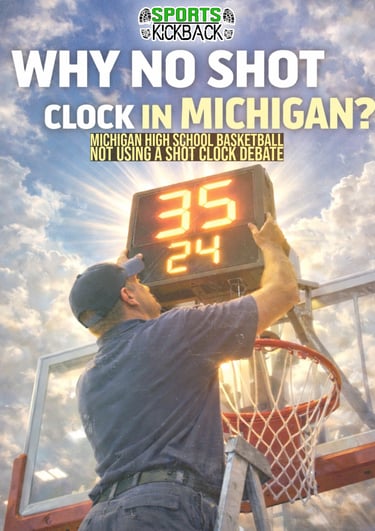
Why No Shot Clock? Michigan’s High School Basketball Debate
Basketball fans across Michigan have heard it at games: “Why don’t we have a shot clock?” It’s a question that keeps coming up in gymnasiums from Detroit to Grand Rapids — but so far, the answer from the Michigan High School Athletic Association (MHSAA) has been no permanent shot clock for regular-season games.
The Current Situation in Michigan
Unlike college and professional basketball, where a shot clock is standard, high school basketball in Michigan generally does not use one. Teams can hold the ball as long as they want, as long as they remain actively trying to score — a strategy known as stalling — because there’s no countdown forcing an attempt.
However, there have been attempts to test the idea. The MHSAA has allowed a 35-second shot clock in showcase events and certain seasonal tournaments — like the Muskegon Basketball Showcase — where schools apply ahead of time and agree to use the clocks. Coaches and players at those events have offered mostly positive feedback, saying the clock quickens the pace and better prepares athletes for college hoops.
Despite these trial runs, the MHSAA’s official stance remains: no permanent shot clock in regular-season games right now.
What Other States Are Doing
Across the country, the landscape is shifting:
After the National Federation of State High School Associations (NFHS) approved the option for a shot clock rule in 2021, more states have moved forward.
States like California, Maryland, Massachusetts, New York, North Dakota, Rhode Island, South Dakota, Georgia, and Washington have long used shot clocks (usually 30 or 35-second clocks).
Schools in states such as Iowa, Minnesota, Montana, and Oregon also use a 35-second clock in high school games.
Even historically slow-to-change states like Kentucky are planning implementation in future seasons.
This patchwork means high school basketball in the U.S. varies a lot: some states force live play with clocks, while others stick with the traditional style that lets coaches and teams manage possession without time pressure.
30, 35, or 24 Seconds — What’s Best?
If Michigan ever adopts a shot clock, the big question will be: how long?
24 seconds is the NBA standard and creates a fast-paced, high-possession game. It pushes teams to make quick decisions, but can feel rushed at the high school level where spacing and execution aren’t always as advanced.
30 seconds is popular in many high school systems and strikes a balance — players get time to run plays, but can’t stall. States like Georgia used this timing when they first adopted shot clocks.
35 seconds is the most popular choice in NFHS adoption, giving high school teams even more room to run a set offense but still preventing intentional stalling.
Each option comes with trade-offs: shorter clocks speed up the game but might disadvantage teams that struggle offensively; longer clocks keep more traditional play styles but may not significantly change possession strategies.
Pros and Cons of No Shot Clock
Pros
Teams can use strategy to control the pace.
Schools with smaller budgets don’t need to buy clocks or hire operators.
Traditional fans argue it keeps the roots of the game alive.
Cons
Games can slow down dramatically, especially when a team is ahead.
The lack of a time limit might not prepare players for college or AAU basketball.
It can make games feel less exciting for fans and scouts.
What’s Holding Michigan Back? Budget, Tradition, or Both?
There are a few reasons the MHSAA and many Michigan coaches haven’t pushed all the way for a shot clock:
School budgets: Quality shot clock systems and updated scoreboards cost serious money — potentially thousands per gym. Hiring or training students or staff to run them also adds cost.
Lack of strong support: Recent surveys show that many schools and administrators currently don’t favor making the shot clock mandatory for every game.
Traditional basketball culture: Especially in the Midwest, there’s a belief among some coaches that the game is fine as it is — that strategy shouldn’t be dictated by a timer.
So the situation feels like a tug-of-war between cost concerns, tradition, and modernizing the sport.
Should Michigan Make the Change?
At the end of the day, most players and many coaches lean toward “yes.” The college game, the NBA, and most competitive leagues use shot clocks — meaning Michigan athletes often experience this for the first time once they reach higher levels.
A shot clock — especially something like a 30- or 35-second clock — would force teams to move, execute, and compete faster, adding excitement for fans and a smoother transition for college-bound players.
But the cost barrier and organizational hurdles can’t be ignored. If Michigan ever fully adopts the shot clock, it will probably come after continued trials, equipment upgrades, and a shift in school commitment.
No matter what side you’re on, one thing is clear: the conversation isn’t going away — and Michigan basketball fans will be watching closely.
Want more high school sports updates and debates like this? Stick with Sports Kickback!