
WHY ARE SMALL SCHOOL PLAYERS OVERLOOKED BY RECRUITERS?
WHY ARE SMALL SCHOOL PLAYERS OVERLOOKED BY RECRUITERS? In today’s recruiting landscape, talent is everywhere — but exposure is not. Every year, elite players from smaller high schools put up eye-popping numbers yet receive minimal college interest. Meanwhile, players at larger schools with modest statistics often attract significant recruiting attention.
HIGH SCHOOL BASKETBALL
3/3/20263 min read
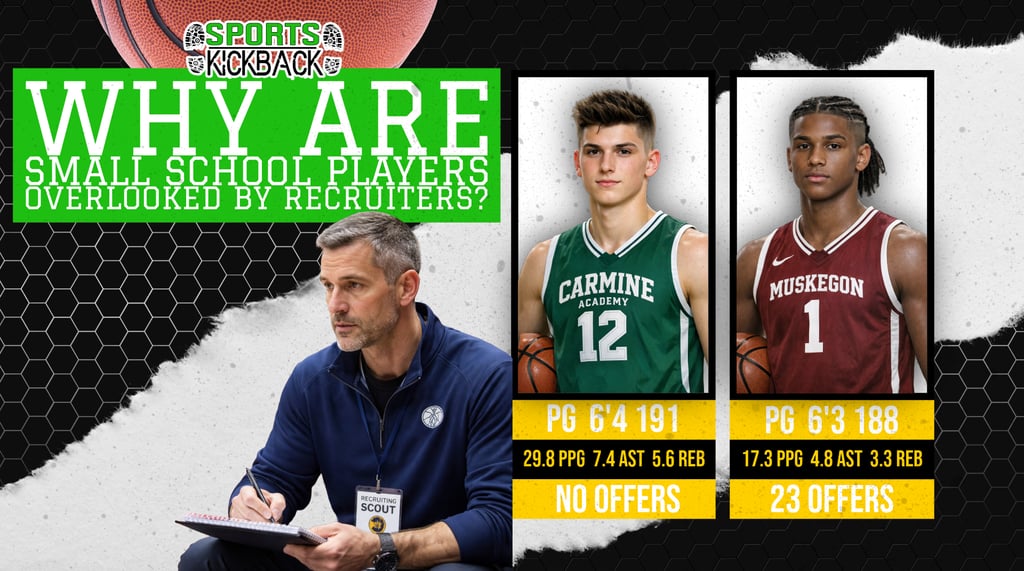

WHY ARE SMALL SCHOOL PLAYERS OVERLOOKED BY RECRUITERS?
In today’s recruiting landscape, talent is everywhere — but exposure is not. Every year, elite players from smaller high schools put up eye-popping numbers yet receive minimal college interest. Meanwhile, players at larger schools with modest statistics often attract significant recruiting attention.
Why does this happen?
The answer usually isn’t about talent alone. It’s about competition level, visibility, and recruiting momentum.
Competition Level Matters More Than Stats
One of the biggest factors in recruiting is who you’re playing against.
In most states, including Michigan, high school divisions are based largely on school enrollment. Bigger schools (Division 1 or Division 2) often have:
Larger talent pools
More multi-sport athletes
Deeper benches
More year-round development opportunities
Smaller schools (Division 3 or Division 4) may have standout individual players, but the overall competition level can vary widely.
A player averaging 30 points per game at a smaller school against average competition may not draw as much attention as a player averaging 15 points per game at a larger school competing against:
Multiple college prospects
Future Division I or Division II athletes
Teams ranked statewide
Recruiters evaluate context just as much as production.
Recruiting Is a Snowball Effect
Recruiting often works like a snowball rolling downhill.
When a college coach comes to watch one highly recruited player, they don’t just evaluate that one athlete — they evaluate everyone on the floor.
Here’s how it works:
A Division I coach comes to see a top-ranked prospect.
While watching, they notice another player competing well against that prospect.
That secondary player now enters the recruiting conversation.
This happens constantly at larger schools and in high-profile games.
Players from smaller schools often don’t benefit from this effect because recruiters aren’t already in the gym. Fewer recruited players in the building means fewer opportunities to be discovered organically.
Travel Ball vs. High School Ball
Travel basketball (AAU) is a major recruiting platform. It provides:
National exposure
Shoe circuit visibility
High-level competition
Direct access to college coaches
However, high school basketball still plays a critical role.
High school season offers:
Structured team systems
Scouting reports and game planning
Rivalry games
District and regional tournament pressure
Many college coaches still prioritize high school performance because it shows how a player performs in a system over a full season — not just in weekend tournaments.
Why Small School Players Get Overlooked
Small school players may be overlooked because:
Lower Visibility – Fewer recruiters in attendance.
Weaker Opponent Strength – Stats may be inflated.
Limited Media Coverage – Less film distribution and hype.
Fewer Recruited Teammates – No snowball effect.
Perception Bias – Assumption that higher divisions equal better competition.
This doesn’t mean small school players aren’t talented — it means they must often work harder for exposure.
Pros & Cons: Big High School vs. Small High School
Big High School (Large Division)
Pros
Higher competition level
More recruiters attending games
Snowball recruiting effect
Stronger practice competition
More media exposure
Cons
Less playing time early on
Harder to stand out individually
Deeper roster = fewer shot opportunities
Internal competition for spotlight
Small High School (Small Division)
Pros
More playing time
Larger offensive role
Leadership opportunities
Strong community support
Ability to develop confidence
Cons
Lower overall competition level
Fewer recruiters in attendance
Inflated stats may be questioned
Less exposure overall
Final Thoughts
Recruiting isn’t just about how many points you score — it’s about who you score them against.
A player averaging 15 points per game in a high-level environment might attract more college interest than a player averaging 30 points in a lower-level division — simply because the competition, exposure, and context are stronger.
For small school athletes, the key is:
Compete at a high level year-round
Use travel ball strategically
Build strong film
Seek out competitive matchups
Create your own visibility
Talent can come from anywhere — but exposure must be intentional.
At Sports Kickback, we believe no player should be defined solely by the size of their school — but by their ability to compete, adapt, and perform when it matters most.
Stay locked in. Stay ready. Your opportunity might come when someone else is being watched.