
Is Reclassing killing youth sports?
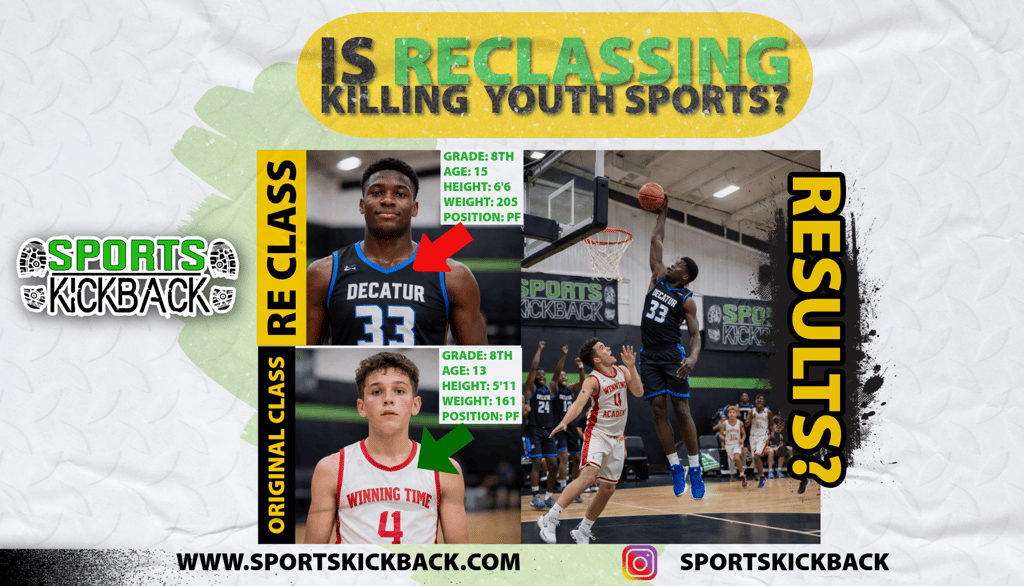
Blog post Is Reclassing killing youth sports? Lets talk about the Pro's and Con's of reclassification for student athletes 8th grade down.
1/22/20263 min read

IS RECLASSING KILLING YOUTH SPORTS?
By Sports Kickback
Youth sports has changed. Between social media hype, national rankings, and the constant chase for scholarships, families are making bigger decisions earlier than ever. One of the most debated? Reclassing.
Reclassing is when a student-athlete is held back a year—usually by 8th grade or earlier—to gain an extra year of eligibility in high school. This is not the same as youth teams cheating by sneaking older kids into games to avoid getting blown out or to pad wins. Reclassing is a long-term developmental decision, and like most things in youth sports, it comes with real pros and real consequences.
So the question becomes: Is reclassing killing youth sports, or is it simply another tool when used the right way?
Why Families Choose to Reclass (The Pros)
For many parents and athletes, reclassing isn’t about shortcuts—it’s about positioning.
1. Skill Development
Some athletes just need more time. An extra year can mean:
Sharper fundamentals
Better basketball IQ
Improved confidence against high-level competition
For borderline or late-blooming athletes, that extra year can be the difference between falling behind and actually catching up.
2. Physical & Emotional Maturity
Not every kid develops at the same pace. Reclassing can allow:
Bodies to mature naturally
Athletes to gain strength and coordination
Emotional growth before varsity-level pressure
This matters, especially in physical sports where confidence and durability are huge.
3. Academic & Educational Reasons
Sometimes the decision has nothing to do with sports:
Stronger academic foundation
Better classroom habits
Maturity to handle advanced coursework later
When education is truly part of the plan, reclassing can be a smart move.
4. Competitive Reality
Some families look at the class ahead and think honestly:
“My kid won’t have a real shot.”
If the older class is loaded with experienced, elite athletes, reclassing can give a player time to develop without being buried on the depth chart.
5. Recruiting Advantage
Let’s be real—this is a big one.
Reclassed athletes often play varsity earlier
They appear more polished than peers
Their bodies are more developed
They gain more film, exposure, and confidence
And if things don’t work out? You can always reclass back up to your original grade. That safety net is part of the appeal.
The Other Side of the Coin (The Cons)
Reclassing isn’t a guaranteed golden ticket—and this is where things get complicated.
1. The Whispers Never Stop
No matter how talented the athlete is, there will always be talk:
“He’s older.”
“That’s why he’s dominating.”
“Put him with his real age group.”
Fair or not, perception follows reclassed athletes everywhere.
2. Diluted Competition
Sometimes the athlete becomes too advanced:
Games aren’t challenging
Growth can stall
Bad habits form because things come too easy
Dominating weaker competition doesn’t always translate to long-term success.
3. False Sense of Security
Reclassing can create an illusion:
Early varsity success
Inflated stats
Hype that doesn’t match future reality
And the hard truth? You still might not make that high-major Division I program you’re dreaming of. An extra year doesn’t guarantee a scholarship—or a pro future.
4. Pressure & Expectations
With reclassing comes pressure:
“You should be better.”
“You’re supposed to dominate.”
When expectations rise faster than development, burnout isn’t far behind.
So… Is Reclassing Killing Youth Sports?
Not exactly.
Reclassing isn’t the villain. Misusing it is.
Every situation is different. The outcome depends on:
Proper development
Honest evaluation
Strong structure and coaching
Clear academic and athletic goals
When reclassing is used as a developmental tool, it can help athletes thrive. When it’s used to chase hype, rankings, or ego? That’s when youth sports suffer.
Final Take
Reclassing isn’t right—or wrong—for everyone. It’s a decision that should be made carefully, honestly, and with the athlete’s long-term future in mind—not just wins, rankings, or social media clout.
At the end of the day, development beats shortcuts.
And no extra year can replace the right environment.
Sports Kickback will always stand on this:
Build the athlete. Build the student. Build the future.